
Sanpete Parole and Probation Compared
Parole and probation both allow a person to live in the community under stated rules, but the source of authority matters. The Utah Board of Pardons and Parole may authorize parole before a prison sentence expires. Utah Department of Corrections Adult Probation and Parole, known as AP&P, then handles field supervision. Probation comes from a court sentence. A Sanpete County probationer may have spent time in the county jail, may have received credit for time served, or may never have entered a state prison.
| Question | Parole | Probation |
|---|---|---|
| Who orders it? | Utah Board of Pardons and Parole | Sentencing court |
| What does it follow? | Release from a prison sentence into supervision | A court sentence served in the community, sometimes after jail |
| Who supervises it? | UDC Adult Probation and Parole | UDC Adult Probation and Parole when assigned |
| Best status source | UDC Legal Status plus the Board order | UDC Legal Status plus the court order |
| Does it mean full discharge? | No, the prison term continues under conditions | No, the court sentence remains active until completion |
The phrase released can mislead here. A parolee has left prison but is not off the sentence. A probationer is supervised in the community, though the status alone does not reveal whether Sanpete County Jail ever held that person. Use the order and custody record to establish the path.
- Parole
- Conditional community release from a prison sentence under Board authority.
- Probation
- A community sentence imposed by a court, with rules and oversight.
- Discharge
- The formal end of the sentence or supervision, not just release from a facility.
- Absconder
- A supervised person alleged to have stopped reporting or whose whereabouts are unknown.
- Rescission
- A Board process that may take away a parole date before release.
Verify Sanpete Post-Release Supervision
The official check starts with UDC, not the public Sanpete booking PDFs. UDC states that its offender search covers people currently under department supervision. That scope can include inmates, parolees, and probationers. It does not turn the system into a full historical archive after discharge, nor does it include every ordinary county detainee. Resolve same-name matches with the offender number and date of birth when those details are available.
- Open the UDC Offender Search and search by exact offender number when possible, or by the person's full name.
- Match the result by offender number and date of birth. Do not rely on a photo or name alone.
- Read Legal Status first. “Parolee” supports prison release into supervision; “probationer” confirms supervision but not a prior prison release.
- Check Housing Location, Board Hearing Date, and Parole/Expiration Date without treating a hearing date or future date as completed release.
- For parole, open the Board decision and check for a later rehearing, rescission, or violation action. For probation, read the sentencing court's order.
- Use the current AP&P regional map, then call the supervising agency when an office assignment or current status needs direct confirmation.
A UDC Legal Status of parolee confirms supervised release from prison, not the end of the state sentence.
No search result is not proof of discharge. It may reflect a spelling mismatch, lack of UDC jurisdiction, or completion of all UDC supervision. For a past status, seek the existing UDC or Board record through the agency's records route.
Note: Match identity and legal status before calling an AP&P office, since the regional office cannot fix a wrong-person search.
Sanpete AP&P Regional Supervision Route
Sanpete County does not operate its own parole department. UDC AP&P routes the county through its regional structure, and current materials identify Sanpete with the Region 4 and Richfield geography. Office assignments and street addresses can change. The live regional map is therefore safer than a copied address. First confirm the person's Legal Status and governing order, then use the map to identify the assigned office.
Sanpete assignment: Region 4 / Richfield geography
Statewide phone: 801-545-5908
Office location: verify on the current regional map
The official UDC Adult Probation and Parole page is the stable entry for supervision information and regional resources.
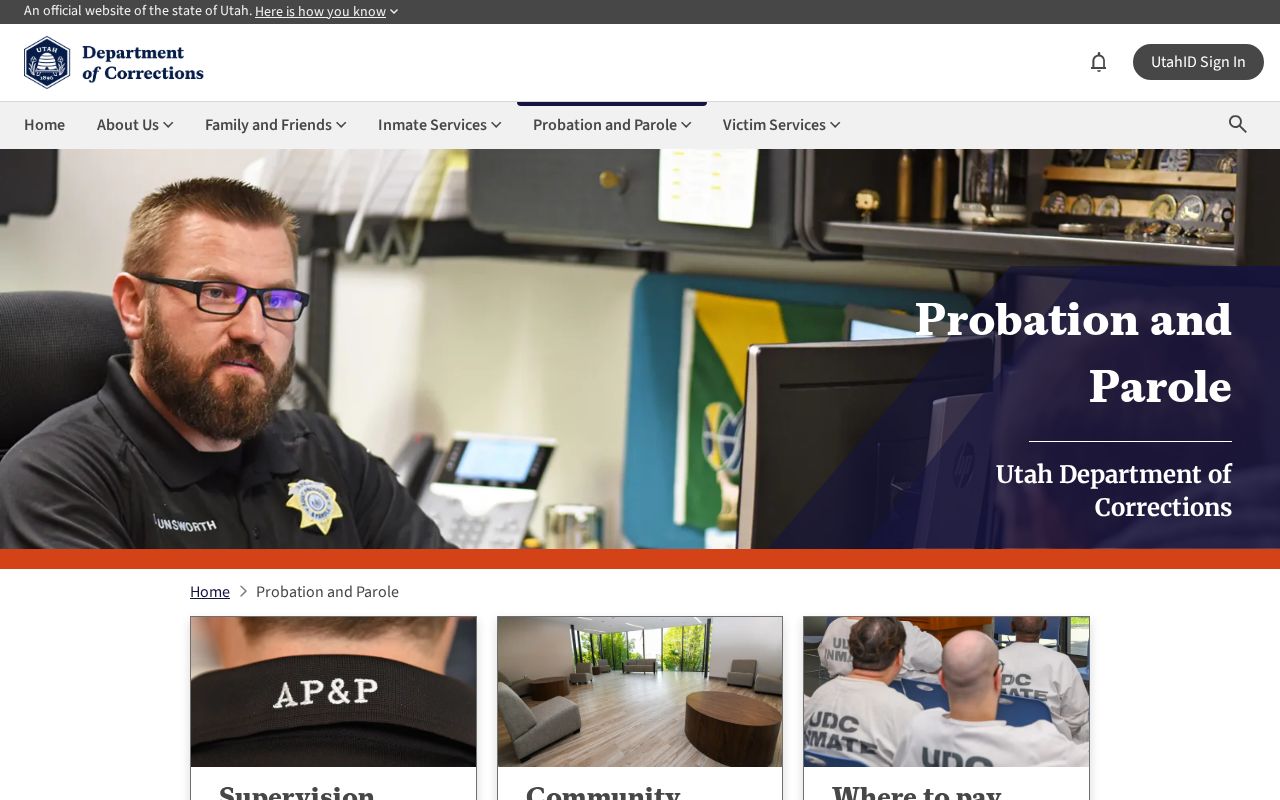
The UDC page helps distinguish field supervision from the Board's decision role. AP&P verifies addresses and handles the day-to-day supervision link. The Board does not verify a parole address.
Sanpete State Placement and Supervision
Sanpete has an unusual overlap between place and legal custody. The county Jail Division holds ordinary local detainees, but it also participates in UDC's Inmate Placement Program. The UDC jail-program booklet reported 76 state inmates at Sanpete and 32 treatment seats, along with related programming. Those people remain state clients even while housed in a county facility.
A state client leaving the Sanpete jail may be moved for state release processing, transferred to another UDC site, or placed under community supervision. Physical departure from the jail does not settle which happened. UDC Legal Status, the Board order, and the receiving placement must align. By contrast, an ordinary local detainee released by bond or a county court order needs the Sheriff's release entry and the court record, not an assumption that AP&P is involved.
Sanpete County geography does not identify the legal custodian; UDC status controls for a state client housed at the county jail.
This distinction matters after release. A state client marked parolee follows the AP&P route. A county detainee who leaves without a UDC status may still have court-ordered probation, but that must be established through the court order and any UDC supervision result.
Note: A move from Sanpete County Jail into another corrections placement is a transfer unless official records show community release.
Sanpete Board Release Decisions
The Utah Board of Pardons and Parole controls parole decisions for eligible state sentences. Its hearing and decision portal supports a person search by first and last name or offender number. Name searches also cover known aliases. A date range can show upcoming hearings or recent decisions for a selected week, and pop-ups must be enabled to open results.
An Original Hearing can grant a parole date or set a rehearing. A redetermination reviews certain long future decisions. Rescission is crucial because it occurs after a date was granted but before release and may remove that date. A violation hearing deals with alleged parole violations after return to custody. Paper Review and Special Attention are administrative review routes, not release events. The specific written order carries more weight than a calendar entry.
The Board search screen shows the controls used to locate scheduled hearings and recent decisions.
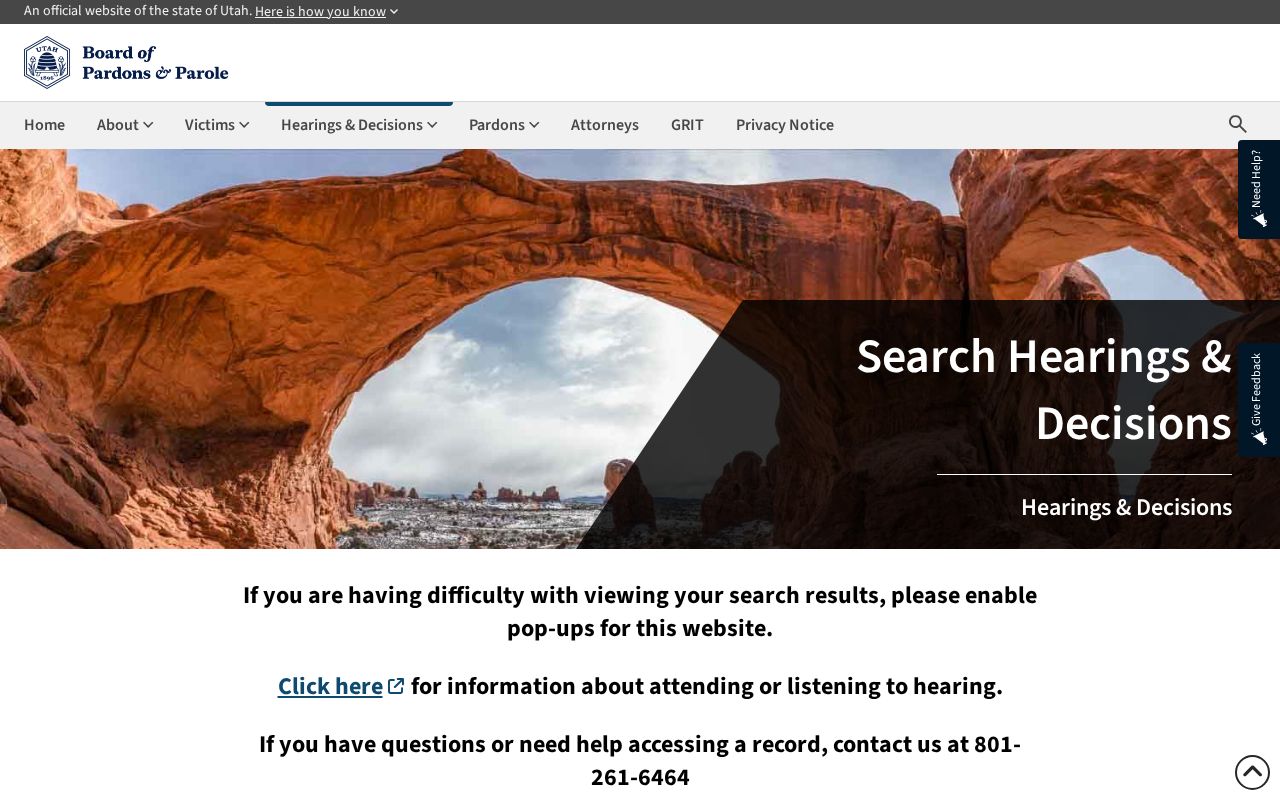
The result should be read with UDC Legal Status. A granted date is not physical release, and Utah law creates no single first-eligibility percentage for all state prisoners. Utah Code section 77-27-7 governs parts of the Board hearing and release process, but an individual's sentence and later orders still control. Broader date factors are covered under Projected Release.
Sanpete Supervision Conditions and Violations
AP&P describes field work that can include reporting, residence checks, assessments, treatment, and case planning. It may also enforce travel, curfew, restitution, fine, and other conditions. These are general examples only. They do not prove the rules imposed on a named Sanpete County parolee or probationer. The Board order governs parole conditions, while the sentencing court order governs probation conditions.
A claimed violation should be separated from a final decision. AP&P may investigate, report noncompliance, or seek a warrant. The Board may amend parole conditions, hold a violation hearing, revoke parole, recall a warrant, reinstate supervision, or use another authorized outcome. A court handles a probation violation under the case before it. The public record may thus contain an allegation, warrant, hearing, and final order with different dates and meanings.
For parole, check the most recent Board order rather than stopping at the first grant. For probation, check the court docket and current UDC Legal Status. Release from one violation hold also does not end the underlying term unless the controlling authority formally discharges it.
Note: A supervision condition should come from the person's Board or court order, never from a generic list of common AP&P rules.
Sanpete Absconder and Warrant Status
An absconder is a person alleged to have stopped reporting or whose whereabouts are unknown while under supervision. UDC explains that AP&P may request a warrant and fugitive personnel may locate and arrest the person. The label therefore points to possible noncompliance during an active supervision term. It does not describe a fresh release and does not, by itself, establish the final result of a violation case.
No standalone Sanpete County absconder list was found in the official sources reviewed. Verification should use UDC Legal Status, the latest Board or court order, and the current AP&P route. A warrant may mean the person is wanted, has been arrested, or is awaiting a later decision, depending on the record date. Confirm the current event with the issuing authority before drawing a conclusion.
VINELink and Sanpete Supervision Events
Utah VINELink can supply a custody event reported by a participating agency and can offer confidential notifications through the methods shown in its current interface. Search one person, match the agency and identifier, and note the displayed status-event date. A released or inactive result means that named agency reports the shown status as of that event. It does not certify freedom from UDC, another jail, federal custody, or a supervision condition.
VINE coverage and data timing depend on source agencies. The research did not establish that every Sanpete County or UDC event is always transmitted. A missing or delayed result can reflect lag, a transfer, an identity mismatch, or a record outside the service. Pair a VINE event with the Sheriff release log, UDC Legal Status, and the controlling order. The Utah registry is also not a general supervision list; it applies only to people with a statutory registration duty.
Ending Sanpete Post-Release Supervision
Release from a facility and discharge from supervision are different events. Parole continues until the sentence ends or the Board enters an authorized termination or other final action. Probation continues until the court and supervising system record completion, termination, or another lawful result. A parolee can live in Sanpete County while still serving a state sentence under conditions.
The public UDC search is designed for people currently under supervision. A fully discharged person may no longer appear. To document the end of supervision, preserve the final Board order or court order and request existing UDC records when the public result has dropped away. Utah GRAMA permits access to public records subject to classification, while private, controlled, sealed, expunged, safety-sensitive, or investigative material may be limited.
The Sanpete County released-inmate search and records route explains how to pair the end of supervision with the original county release entry. That pairing separates the jail departure date from the later date when probation, parole, or the sentence itself ended.